Please Visit Rolex.2itb.com http://www.horsyland.com https://photographic-experience.blogspot.hk/
Thursday, July 03, 2008
Wednesday, July 02, 2008
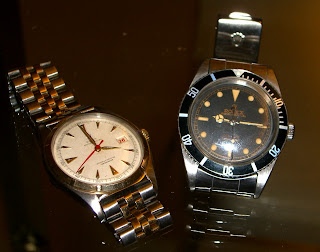
Rolex GMT Ref 6542


The 1950s rolex GMT 6542 has its history with Pan-Am, where it commissioned a watch to be designed with specification, enbling the pilots to keep track of time in two locations. It has an additional hour hand that revolved once every 24 hours and a rotating bazel. The watch was designed by Captain Frederic Libby and Rene-al Jeanneret.
The Rolex 6542 was produced from 1954 to 1960 with distinct mercedes hands, and a transparent acrylic insert bezel (material chosen to cut down reflectivity for better legibility) as well as its distintiive feature of not having the crown guard (similar to the eraly James Bond submariners 6500, 6502, 6504, 6536, 6538, 5508 and 5520).
The Ref 6542 was later replaced by Red 1675, 16750 with the crown shoulder guard. The Rolex GMT was often known as the "Pepsi" bezel owing to the similiarity of colours!
For those who is keen to get one can visit:
http://www.chrono24.com/web/us/suchen/u/index.htm?myfunction=&myadcode=&do_suche=1&statbrand=0&debug=&BRAND_ID=0&MODEL=rolex+6542&SEARCH_PRICECURRENCY=USD&SEARCH_PMIN=0&SEARCH_PMAX=0&SUCH_MATERIAL_ID=0&LOCCOUNTRY_ID=&SEARCH_REGION_ID=&ENTERDATE=&SORTORDER=1
Rolex Red Submariner 1680


There are 2 versions of the 1680: mark 1 using cal 1556 and mark 2 using 1570 and the Ref 1680 weres produced from 1969-1978- 80. The 1680 series has a special dial using red SUBMARINER.
Within this 12 year period the Red Submariner is widely believed to be produced for the first 6 years, 1966-73. Many original Red Submariners have been serviced and as a result, many would have had their original red dials replaced with the standard white dials during the years making it quite rare to find the Red submariner.
As for the depth there are two versions one with the feet first while the other in meters depending on the region, I guess.The 1680 was succeed by the Ref 16680 using cal 3035, Ref 16610 using cal 3135.
Sunday, June 22, 2008
Vintage watch hobby
The vintage watch collection hobby has been on a quiet side as the "fever" has not been as strong as during the 1980s-90s...those good old days!
However, there is a strong trend towards Vintage Sports watch collection (GMT, Submariner, Explorer, Daytona). The prices of these sports models have escalated so much over the years!
Recently, with the encouragement of my new colleague Dominik, I have began to take out my old collection and start to play with my watchs again! Thanks Dominik!
The hifi audiophiles are too political for my liking... Enjoy!
Saturday, May 03, 2008
Atmos Clock JLC

This is a vintage JLC atmos clock from the 1960s. This is one of the classic which automatic wind as a result of the change in room temperature. No winding require!
The clock moves in very elegant manner slowly and in very gentleman manner.
I have always wanted one but the prices are so expensive and often they are not in working condition!
I have manage to find one at the flea street in Hong Kong! It is in good working condition and I remembered bringing it home and the sky was raining! Even though I was wet, I was feeling very happy : )
For details:
The History Of The Atmos Clock
"Living On Air"
The History of the Legendary Atmos Clock:
In the late 1920s Jean-Leon Reutter, a young Paris engineer, experimented with a clock that needed no direct mechanical or electrical intervention to keep it wound, in short a clock powered only by Perpetual Motion.
For centuries, many scientist including Leonardo Da Vinci had experimented with the idea of Perpetual Motion - however, only J.L. Reutter eventually succeeded at incorporating that novel idea into an actual working clock.
Through out his life, J.L. Reutter's dream of a Perpetual Motion timepiece led him to produce a clock with a timekeeping mechanism designed specifically to consume the smallest possible amount of power to keep the clock running satisfactorily.
After studying the design of the 400-Day Anniversary Clock -which was very popular during that era - Reutter made significant changes to that concept, to meet the small input power requirement he was looking for in his new clock design.
Reutters modifications of the 400-Day Clock included changes to the escapement leverage to reduce the arc of the escapement as well as adding jewels to the bearings of the movement. His new clock ran safely and most importantly very reliably.
His new clock design included a special device that would power his clock independently, using a substance that would react to the most sensitive changes in temperature and atmospheric conditions. That substance was mercury. He also designed a special glass tube similar to that of a thermometer for the mercury and encased it all inside a metal cylinder, which is now known as the Bellows.
The result of Reutters achievement was an ingenious new clock unlike any other, past or present. A timepiece that could run independently and continuously and so incredibly sensitive, that it could be rewound by the slightest fluctuations in the atmosphere, or by the slightest changes in temperature, hence the name: "Atmos Clock".
Later, due to dangers in handling and instability, the mercury in the Bellows that powered the Atmos Clock was changed to a special more stable saturated gas, known scientifically as 'Ethyl Chloride'. The technological concept of the Gas filled Atmos Bellows is a remarkable one: Inside a sealed capsule, a mixture of gas and liquid expands as the temperature rises and contracts as it falls, moving the capsule back and forth like a tiny unseen accordion. This motion is used to constantly wind the mainspring thus enabling the clock to run and keep perfect time. A small temperature variation of just one degree is sufficient for over two day's operation. Such variation occurs naturally in normal room temperature and thus without any additional sources of energy, the Atmos clock will continue to run if left untouched, "forever". Hence the term: "Living On Air".
The Marriage of Atmos and Jaeger-LeCoultre
When Reutters Atmos was in its initial production in the early thirties, the lack of enthusiasm from manufactures in general during that time made production of the Atmos clock difficult. Reutter Atmos was in production, but only in small numbers.
Legend has it, while Reutter struggled with production of his Atmos Clock, the manager of a famous Swiss watch making company LeCoultre (a company world famous for fine Swiss watches located in the French Valley of Switzerland) was strolling down a street in Paris one day and noticed one of Reutters Atmos Clocks sitting in a shop window for sale. The man was so fascinated with Reutters Atmos; he walked in and purchased it from the shop merchant.
Later, after a chance encounter between LeCoultre and Reutter he (Reutter) agreed to sell the license and eventually his Atmos Clock patent to the LeCoultre Watch Company.
At the time of LeCoultres acquisition of the Atmos patent, LeCoultre was in fierce competition with another Watch Company, Ed Jaeger of Paris. Eventually LeCoultre merged with Jaeger to form the famous watch making company: Jaeger-LeCoultre.
With the combined knowledge and expertise of their newly joined Company, Jaeger & LeCoultre poured considerable investment collective research and development into Reutter's Atmos Clock. Just a few years later, major production of the newly revamped Atmos Clock was launched under the Jaeger-LeCoultre name exclusively.
The LeCoultre Atmos Clock soon became a very fashionable, prestigious gift in Switzerland and eventually Worldwide.
As the success of both Jaeger-LeCoultre and the Atmos clock continued to grow, the company prospered and in 1979, the 500,000th Atmos Clock left the Factory in Switzerland with much celebrated fan-fair, a half a century after the first Atmos Clock patent was filed.
The History Of The Atmos Clock
"Living On Air"
The History of the Legendary Atmos Clock:
In the late 1920s Jean-Leon Reutter, a young Paris engineer, experimented with a clock that needed no direct mechanical or electrical intervention to keep it wound, in short a clock powered only by Perpetual Motion.
For centuries, many scientist including Leonardo Da Vinci had experimented with the idea of Perpetual Motion - however, only J.L. Reutter eventually succeeded at incorporating that novel idea into an actual working clock.
Through out his life, J.L. Reutter's dream of a Perpetual Motion timepiece led him to produce a clock with a timekeeping mechanism designed specifically to consume the smallest possible amount of power to keep the clock running satisfactorily.
After studying the design of the 400-Day Anniversary Clock -which was very popular during that era - Reutter made significant changes to that concept, to meet the small input power requirement he was looking for in his new clock design.
Reutters modifications of the 400-Day Clock included changes to the escapement leverage to reduce the arc of the escapement as well as adding jewels to the bearings of the movement. His new clock ran safely and most importantly very reliably.
His new clock design included a special device that would power his clock independently, using a substance that would react to the most sensitive changes in temperature and atmospheric conditions. That substance was mercury. He also designed a special glass tube similar to that of a thermometer for the mercury and encased it all inside a metal cylinder, which is now known as the Bellows.
The result of Reutters achievement was an ingenious new clock unlike any other, past or present. A timepiece that could run independently and continuously and so incredibly sensitive, that it could be rewound by the slightest fluctuations in the atmosphere, or by the slightest changes in temperature, hence the name: "Atmos Clock".
Later, due to dangers in handling and instability, the mercury in the Bellows that powered the Atmos Clock was changed to a special more stable saturated gas, known scientifically as 'Ethyl Chloride'. The technological concept of the Gas filled Atmos Bellows is a remarkable one: Inside a sealed capsule, a mixture of gas and liquid expands as the temperature rises and contracts as it falls, moving the capsule back and forth like a tiny unseen accordion. This motion is used to constantly wind the mainspring thus enabling the clock to run and keep perfect time. A small temperature variation of just one degree is sufficient for over two day's operation. Such variation occurs naturally in normal room temperature and thus without any additional sources of energy, the Atmos clock will continue to run if left untouched, "forever". Hence the term: "Living On Air".
The Marriage of Atmos and Jaeger-LeCoultre
When Reutters Atmos was in its initial production in the early thirties, the lack of enthusiasm from manufactures in general during that time made production of the Atmos clock difficult. Reutter Atmos was in production, but only in small numbers.
Legend has it, while Reutter struggled with production of his Atmos Clock, the manager of a famous Swiss watch making company LeCoultre (a company world famous for fine Swiss watches located in the French Valley of Switzerland) was strolling down a street in Paris one day and noticed one of Reutters Atmos Clocks sitting in a shop window for sale. The man was so fascinated with Reutters Atmos; he walked in and purchased it from the shop merchant.
Later, after a chance encounter between LeCoultre and Reutter he (Reutter) agreed to sell the license and eventually his Atmos Clock patent to the LeCoultre Watch Company.
At the time of LeCoultres acquisition of the Atmos patent, LeCoultre was in fierce competition with another Watch Company, Ed Jaeger of Paris. Eventually LeCoultre merged with Jaeger to form the famous watch making company: Jaeger-LeCoultre.
With the combined knowledge and expertise of their newly joined Company, Jaeger & LeCoultre poured considerable investment collective research and development into Reutter's Atmos Clock. Just a few years later, major production of the newly revamped Atmos Clock was launched under the Jaeger-LeCoultre name exclusively.
The LeCoultre Atmos Clock soon became a very fashionable, prestigious gift in Switzerland and eventually Worldwide.
As the success of both Jaeger-LeCoultre and the Atmos clock continued to grow, the company prospered and in 1979, the 500,000th Atmos Clock left the Factory in Switzerland with much celebrated fan-fair, a half a century after the first Atmos Clock patent was filed.
Friday, April 18, 2008
Vintage Breguet Type 20


The Vintage Breguet Type XX was commissioned by a famous French military in the 1950s used by the French Air Force, Flight Testing Center and Naval Air Alarm.
The Type 20 had a number of features that apparently were military specifications. The case was relatively large for a military watch at 38mm, with black dial, luminous Arabic numerals and hands, a sweep second center column chronograph hand, and 2 subdials at 3 and 9 o'clock. The subdial at 9 was a small seconds indicator. The chronograph elapsed time subdial at 3 had special markings for 3, 6 and 9 minutes. The bezel rotated, in order to keep track of elapsed time.
For more details, please visit:
http://www.classicwatch.com/asp/articles/type20.asp
Thursday, April 17, 2008
My Grandfather's watch
Monday, December 03, 2007
Sunday, October 21, 2007
James Bond Rolex 6536 (with no crown guard)


http://en.wikipedia.org/wiki/Rolex_Submariner
Early Submariners (1953-1967)
The Submariner model went into production in 1953, and was showcased at the Basel watch fair in 1954. The assigned case reference number of this first Submariner was either 6204 or 6205. It is unclear which model came first and, in any event, the two watches are nearly identical. Neither has the distinctive "cathedral" or "Mercedes" hands now so strongly associated with the Submariner line. Rather, both of these early submariners have straight "pencil" style hands.
Few if any of the 6205 watches bear the name "Submariner" on the dial, a major distinction with modern submariners. Some 6204 models have the Submariner logo printed below the center pinion, while others have the logo blacked out. It is believed that there were unexpected trademark issues connected with the name "Submariner" at the time the 6204 and 6205 were released which account for the inconsistent use of the Submariner mark on these early Submariners. Trademark irregularities notwithstanding, both the 6204 and 6205 are designated Submariner models in the Rolex product literature of the time.
In 1954, Rolex also produced a small number of ref. 6200 Submariners. This was the first Submariner (although not the first Rolex) to make use of the Mercedes hand set ( a feature of all subsequent Submariners). The 6200 also featured an oversized winding crown (compared with the 6204 and 6205 models).
Within a few years, Rolex revised its Submariner line, producing the 6536 (small crown) and 6538 (oversized crown) models. These watches had "improved" movements (the cal. 1030), including a chronometer version in some 6536 models (designated 6536/1), the now-familiar Mercedes hands, along with the Submariner logo and depth rating printed on the dial.
By the early 1960s, these models gave way to the 5508 (small crown) and 5510 (large crown) models. All of these early Submariners used either gilt (6200, 6204, 6205) or gilt/silver gilt (6536, 6538) printing on glossy black dials. Radium paint was used for the luminous indices.
The next wave of Submariners, the 5512 (chronometer version) and 5513 (non-chronometer) marked a significant change in the appearance of the popular Rolex design. "Shoulders" were added to the crown side of the case to provide protection for the winding/setting mechanism. In early watches -- perhaps until 1964 or so -- these shoulders were pyramid-shaped, ending in points. Later watches were manufactured with rounded shoulders. In addition, the 5512 and 5513 were both fitted with the oversized crown, which became a standard feature of the Submariner line thereafter. Sometime in the early 1960s, Rolex discontinued the use of radium paint for the luminous indices, switching to the comparatively safer Tritium-infused paint. In 1965-1966, Rolex discontinued use of gilt/silver gilt dials on the Submariner watches, switching to white printing. A final important change came with the introduction of the 1680 model in the late 1960s. The 1680 was the first Submariner to be equipped with a date complication, marking the completion of the transition of the Submariner line from specialist tool watch to mass market fashion accessory. While many professional and military divers used -- and continue to use -- Submariners in the most demanding underwater environments, by the late '60s the watch had undeniably become a mass market product, as well. Throughout the next 40 years, the Submariner was updated with improved water resistance, new movements, and numerous small cosmetic changes. Nonetheless, the modern Submariner of today bears a very strong resemblance to the 5512 or 5513 of the early 1960s, and is an unmistakable descendant of the very first Submariners introduced more than fifty years ago.
In 2003, Rolex celebrated the Submariner's 50th anniversary by launching the Rolex Submariner anniversary edition ( 16610 LV) . Its distinguishing features were the green bezel and Maxi dial.
Tuesday, September 18, 2007
Rolex Big Bubbleback Ovettone with date

This is a rare ROLEX OYSTER DATE , aka "big bubblebacks" or called Ovettone by Rolex .
This is a s/steel and gold oyster case band , auto date , cal.740 , super oyster crown
red and black date [ so called roulette date ] ref.6031 [ 36 m/m dia. case ] c1951
signed case , dial , movement , band [ orig. later added steel & gold band ]
This is a s/steel and gold oyster case band , auto date , cal.740 , super oyster crown
red and black date [ so called roulette date ] ref.6031 [ 36 m/m dia. case ] c1951
signed case , dial , movement , band [ orig. later added steel & gold band ]
There are two versions of the vintage Big bubbleback, the Rolex Ref 4467 & 6031 using the real and thicker bubbleback movement, and the dial wording Rolex Oyster perpetual; and the later Model ref 6105 and 6305 Ovettone, with dial Rolex Oyster perpetual DATEJUST , using the slightly flatter semi bubbleback movement. Produced in less than 1000 examples from 1950-1952.
I have stopped actively collecting vintage watches for nearly 2 years asI was pre-occupied with my vintage hifi equipment.
Lately, I have managed to come across a nice Big bubbleback 6031 and the desire to try to add in the big bubbleback to my bubbleback collection grew. I have managed to find the small bubbleback, the medium size bubbleback, the semi bubbleback but not the Big bubbleback Ovettone. Now, I am eagerly waiting for the arrival of my Ovettone! The bracelet is a later Rolex bracelet..
Subscribe to:
Posts (Atom)
Problem with signing in
I am facing issues with saving my blog with photos and I cannot seemed to log on using my ipad. Perhaps, the days have pme to end the blog....
-
I have managed to bring down the number of watches this week with the letting go of a spare ZRC and Duward diver. In coming is a Rolex...
-
2019 is going to be a good year as I have managed to find a nice 42mm Droz super compressor from Stockholm Sweden. Droz R.A.N. (Royal Austra...
-
According to Horological Journal January 2004, there are a few versions of IWC Mark XI. My guess is that there are more than 4 versions. E...


